Some pictures from St. Nick's Day at the Old Stone House - December
Yes, young friends, there is a Saint Nicholas!
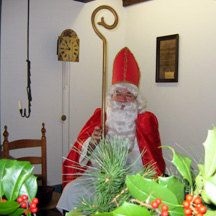 He's a legendary figure who lived in the Fourth Century, serving as bishop of Myra in Asia Minor, and winning long-lasting fame for his kindness to people in need -- most especially children. That's why, almost 1700 years later, he's known as the patron saint of children.
We see him as an old man with a white beard. Just like your good friend Santa Claus (who is actually the same man!)
There are many stories about Saint Nicholas. One tells of how he gave three bags of gold to the daughters of a poor man who were so desperate that they were about to go out into the streets to beg. He slipped the bags through a window as a mysterious gift, and saved the family from poverty. Even today, gold balls are used as a symbol for pawnbrokers, inspired by his giving.
Nicholas was born in an ancient Lycian seaport and as a youth traveled to Palestine and Egypt, serving as Bishop of Myra when he returned to home. When the Emperor Diocletian began to persecute early Christians, he was imprisoned, but he was released when Constantine the Great became emperor, and attended the first Council of Nicea in the year 325. Always, throughout his service, he was noted for his generosity and loving kindness.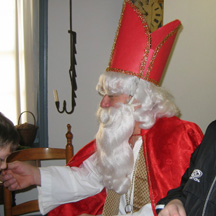
He was buried in Myra, but in 1087 Italian sailors and merchants took his remains to Bari, where he is enshrined in the 11th century basilica of San Nicola.
In the Middle Ages, the generosity and caring of Saint Nicholas became a trademark and his legends extended all over Europe. He became the patron saint of Russia and Greece, as well as the patron saint of children, sailors, unmarried girls, merchants -- and pawnbrokers.
Thousands of European churches are dedicated to him, one as early as the Sixth Century which was built by the Roman emperor Justinian I in Constantinople, now Istanbul.
There was a special Boy Bishop ceremony on his traditional freast day in early December, when a boy was elected "bishop" and reigned until Dec. 28 each year on Holy Innocents Day. The cult began to disappear after the Reformation everywhere except in Holland -- and that's where we come in. There his legend persisted as Sinterklass, a Dutch variant of his name. The sixth of December became his feast day, a children's holiday with traditional gifts giving for all good boys and girls.
When the early Dutch colonists came to America, they brought along the custom. New Amsterdam (now New York) was the start of observance here in the 1600s.
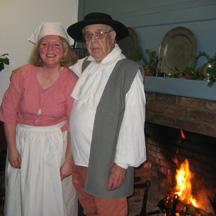 And so Saint Nicholas Day was an important one, back when the Old Stone House was a new home for early Dutch settlers here. The British settlers who came to this area liked the whole idea, too, and adopted him as Santa Claus (in the United Kingdom, Father Christmas). They built on the legend of a kindly old man who punished naughty children and gave presents to good ones.
The whole Saint Nicholas - Santa Claus image crystallized in the 19th century in America.
He's truly the patron saint of giving!